Jeff Shesol writes about the differences between Obama and FDR:
Heading into his first midterm, Roosevelt, too, faced an ailing economy and critics blasting him as a socialist. Jeff Shesol on how he beat the odds—and what Obama needs to tell America now.
FDR was not subject to a mid-term disaster that Obama seems to be heading toward, because he had vision.
One of the main reasons FDR prevailed—then and thereafter—was his ability to paint a clear, consistent picture of the kind of country he wanted America to be, the kind of country we needed to be in the industrial era.
....
In his inaugural address, President Obama spoke of a “new era of responsibility,” but soon dropped the idea in favor of another unifying theme (wrapped in a laundry list, inside a mixed metaphor): a “new foundation… built upon five pillars that will grow our economy.” The pillars—financial reform, education, clean energy, health care, deficit reduction—tell us a lot about his priorities, but little about his basic objectives. Where does this all lead? What defines Obama’s America? Absent a clear answer, Obama has, in effect, asked the country to infer his goals by inductive reasoning—to assume that on the basis of policies A, B and C, Barack Obama seeks X, Y, and Z.
I'm not sure if Obama is lacking in vision or is just unable to communicate it. What he has done is a number of individual acts, each that stands on it's own. It adds up to something very similar to what FDR did, but they don't reflect an overall vision for the country, nor do most people even know what he's done.
I sure hope he can turn this around. If we have fewer Democrats in the House and Senate things will jsut get tougher for him.
Obama gave a speech today. We all know he’s good at speeches but for this one he dropped the soaring and inspiring prose and settled into the role of an economics professor and explained in simple terms why he was doing the things he’s doing to get the economy going again. All very good and, unfortunately, very necessary for the stupid American public who are getting mad about things that they don’t even understand.
Obama is doing what any smart guy would do, looking at history and learning it’s lessons. The best example we have of our situation is The Great Depression.
Very easy to look at the things Hoover did, all of which caused a deeper and worse depression. And look at what FDR did that started us back on the road to being able to live.
The first thing Hoover did, and which he is most known for is - nothing. He just stood there and said there was nothing he COULD do, the economy would correct itself. As we can see, Republicans have followed ideology over reality for over 75 years. FDR showed (and this is actually Keynesian economics, FDR didn’t invent it) that spending at a time when only the government has the muscle for any kind of big spending, is the necessary thing for a completely stagnant economy. Another thing Hoover got raked over the coals for was raising taxes, which was like throwing gasoline on a fire. This is why Obama hasn’t raised taxes for the rich yet like he said he was going to. He’ll just wait for the Bush tax cuts to expire next year and hope the recovery is far enough along that it won’t hurt.
This I have some doubts on, that raising the top tax rate from 36% to 39% is going to cause much of a problem. It might even be stimulative as the rich might want to make business investments to lower their taxes. Keep in mind that we have a marginal tax, which means the percentage increases with quantity - the 39% kicks in at amounts over $400,000. And that rate is ONLY paid on income over that limit, not below it. Still, I can understand being cautious and won’t fault Obama for not wanting to risk raising taxes right now.
But where I do find fault is what Obama said about not nationalizing the banks the way Paul Krugman has been saying he should. I kind of felt like Obama couldn’t justify that either and gave the least amount of explanation on that part. I think he is just staying away from what most of the country sees as socialism. But Krugman actually IS an economics professor at Princeton, unlike Obama who only plays one in speeches, and he recently won the Noble Prize in Economics, no small feat.
First we need an explanation of what Krugman means by nationalizing the banks, he doesn’t mean for the government to start running banks, they aren’t in the banking biz and shouldn’t be. It means the government steps in and seizes a failing bank and pretty much guts it, getting rid of it’s toxic assets, shareholders and officers. Then they sell it and let new management come in and start fresh. The best part of this is that it throws the assholes out on the street who brought the entire world’s economy to it’s knees. The bailout is giving these very same assholes billions of dollars to do what they want with, like give themselves million dollar bonuses and buying company jets. I think this is the single worst thing Obama is doing, letting the same guys remain in their positions to wreck more havoc. The big disadvantage to nationalizing is that all the shareholders suffer 100% loss, no chance of ever getting it back. With all the IRA’s out there right now that could mean a big hit to a lot of middle class people, not just rich guys.
That kind of hit could be worse than raising taxes in today’s economic climate. That’s probably what Obama is worried about, although I’m sure he’s more worried about looking like a socialist.
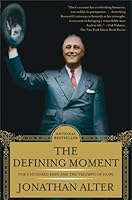
Cover via AmazonJonathan Alter, who has been on Countdown and Rachel Maddow Show often as well as on many progressive radio shows, wrote a book called "The Defining Moment: Franklin Roosevelt and the First Hundred Days". It's been said that Obama read the book several times and was very impressed, and he has used the phrase "This Is The Defining Moment" several times.
This is something I've wanted to see, that Obama realized that we are in a situation eerily similar to when FDR entered the presidency in 1932. It's important because FDR gave us 50 years of prosperity and a large middle class for the very first time. It only started falling apart when Reagan came into office and started dismantling all of it, which has led us directly to where we are now.
My favorite economist Paul Krugman wrote a long article on this called "What Obama Must Do" and brought up what FDR did. Image by Getty Images via DaylifeBut he had more detail:
The last president to face a similar mess was Franklin Delano Roosevelt, and you can learn a lot from his example. That doesn't mean, however, that you should do everything FDR did. On the contrary, you have to take care to emulate his successes, but avoid repeating his mistakes.
He then goes on to say that creating universal health care would be his biggest legacy:
Back in 1993, when the Clintons tried and failed to create a universal health care system, Republican strategists like William Kristol (now my colleague at The New York Times) urged their party to oppose any reform on political grounds; they argued that a successful health care program, by conveying the message that government can actually serve the public interest, would fundamentally shift American politics in a progressive direction. They were right — and the same considerations that made conservatives so opposed to health care reform should make you determined to make it happen.
Think for a moment about what Kristol said - they should oppose health care not because it is bad for America but because it is good for America. It would destroy their myth of government always bad and turn us in a proghressive path. He was perfectlyt willing to let people die due to lack of health care in order to advance the Republican political agenda. This is why I call Republicans evil.
Universal health care, then, should be your biggest priority after rescuing the economy. Providing coverage for all Americans can be for your administration what Social Security was for the New Deal. But the New Deal achieved something else: It made America a middle-class society. Under FDR, America went through what labor historians call the Great Compression, a dramatic rise in wages for ordinary workers that greatly reduced income inequality. Before the Great Compression, America was a society of rich and poor; afterward it was a society in which most people, rightly, considered themselves middle class. It may be hard to match that achievement today, but you can, at least, move the country in the right direction.
What caused the Great Compression? That's a complicated story, but one important factor was the rise of organized labor: Union membership tripled between 1935 and 1945. Unions not only negotiated better wages for their own members, they also enhanced the bargaining power of workers throughout the economy. At the time, conservatives warned that wage gains would have disastrous economic effects — that the rise of unions would cripple employment and economic growth. But in fact, the Great Compression was followed by the great postwar boom, which doubled American living standards over the course of a generation.
So we need health care and robust unions, the very things Republicans fight tooth and nail to stop. I very much recommend reading all of Krugman's article. It is long but easy to read and chock full of details. You will understand just how bad off we really are right now and what needs to be done to fix it.
Massimo Pigliucci is one of my favorite writers on philosophy and politics. Despite the fact that he’s a scientist he writes often on these things and I’ve found myself in agreement with him almost every time, even more than I agree with Dawkins. He really nails my feelings of bipartisanship in his latest blog entry: Why I don’t believe in bipartisanship:
Let me start with an example from my native country, Italy. For the past couple of decades Italy has been de facto a country with two parties: although there are in theory many parties big and small, they gravitate toward one of two “poles,” and it is one or the other of these two coalitions that has held power in the country for several years at a time. Now, just like in the US, the Italian left often speaks of bipartisanship and cooperation, and they (largely) mean it; as a result, the Italian left gets almost nothing of relevance done while in power. Then it’s the other guys’ turn, and they plunge head down with their agenda, completely oblivious to and even openly scornful of calls for cooperation and compromise. The result is that Italy has been on a steady trajectory to become one of the most regressive, unjust and racist countries in Europe. And unfortunately I do not see a reversal of this slide for many years to come, given the apparent inability of the left to mount any significant opposition to the Berlusconi government.
This is what I’m afraid of, that Obama will bend over backwards to try and create a union with the right wingers and the end results will be actions so watered down as to be worthless or simply obstructionism that prevents anything from getting done. We only have a short time to work before the pendulum swings back to the right so we don’t have time to waste. Even worse, if Obama does not deliver the Democrats might not be in charge past his administration.
When FDR took over and created the New Deal in the 30’s it lasted until 1980 when Reagan started taking it apart. And did Reagan or any Republican ever worry about bipartisanship? Not one damn bit, they plowed ahead and did what they wanted, no matter how outrageous. FDR's legacy of liberalism lasted so long because he was incredibly successful and got a lot done. Obama has to do the same if we want the Democrats to hold power for long. And don't think the Republicans don't know this, they will want to stop as much as they can.
 Image via Wikipedia


![Reblog this post [with Zemanta]](http://img.zemanta.com/reblog_e.png?x-id=8df0fee0-afdf-4981-94b7-c92b00c91fb1)

![Reblog this post [with Zemanta]](http://img.zemanta.com/reblog_a.png?x-id=bb8d73c3-3e39-46a7-acb3-3fb2dd6aaee2)